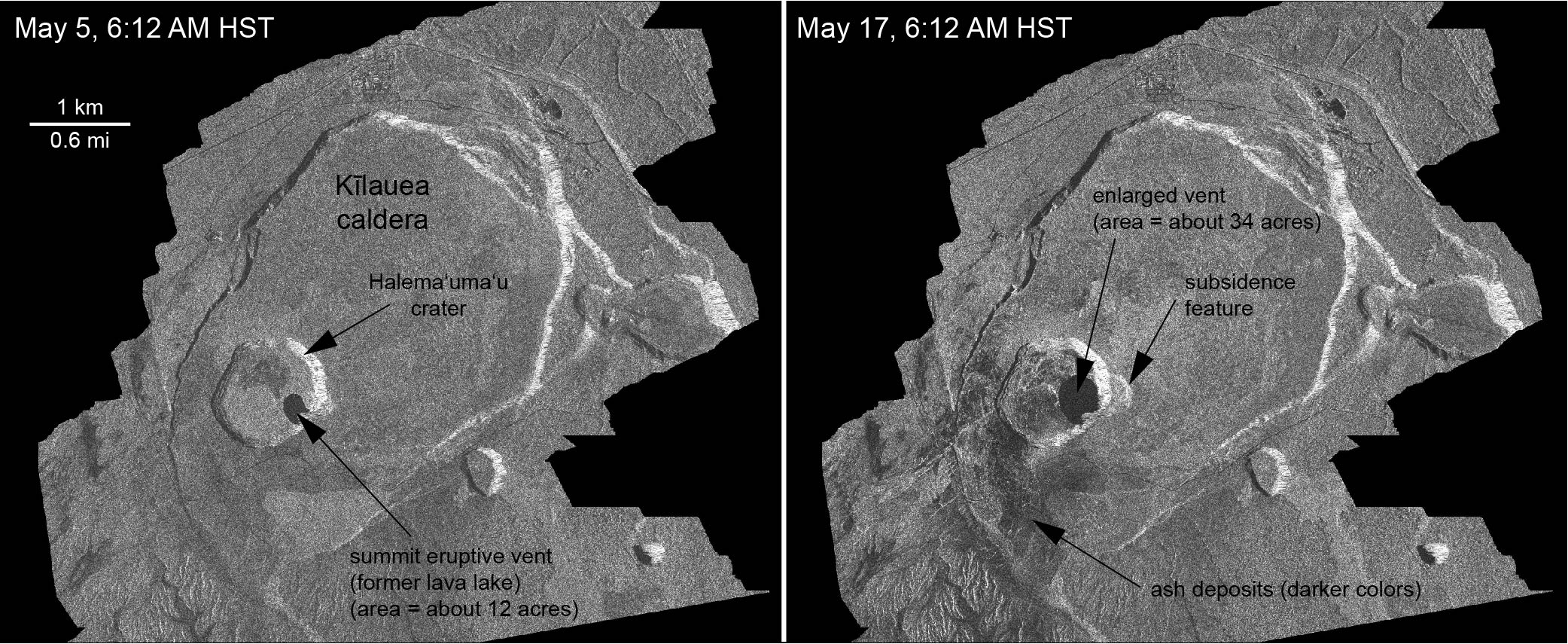
BigIslandVideoNews just put up an edited video of Saturday’s USGS press conference. My hero Don Swanson is there. It’s INCREDIBLY informative on what they think is happening at the summit and why they think it’s a repeat of the “much smaller eruptions” of 1924 and not larger ones.
There’s two lava livestreams on Youtube this morning, same location, Honolulu CivilBeat mostly focusing on Fissure 20, ~1000 yards away. WXchasing moving camera more often [ETA: WX stream now archived]. HCB said Fissure 17 (3/5 a mile away) has built up a cinder cone 300 feet tall.
Last night, Fissure 20’s lava flow crossed Highway 137 and reached the ocean at 11PM, leaving some Puna residents with one escape route. Filed under “things I didn’t know,” Civil Defense warns of “Laze,” a spray of hot steam, hydrochloric acid, and “fine glass particles” when lava hits seawater.
Also filed under “things I didn’t know”: “Methane gas, produced as lava buries vegetation, can migrate in subsurface voids and explode when heated.” (USGS)
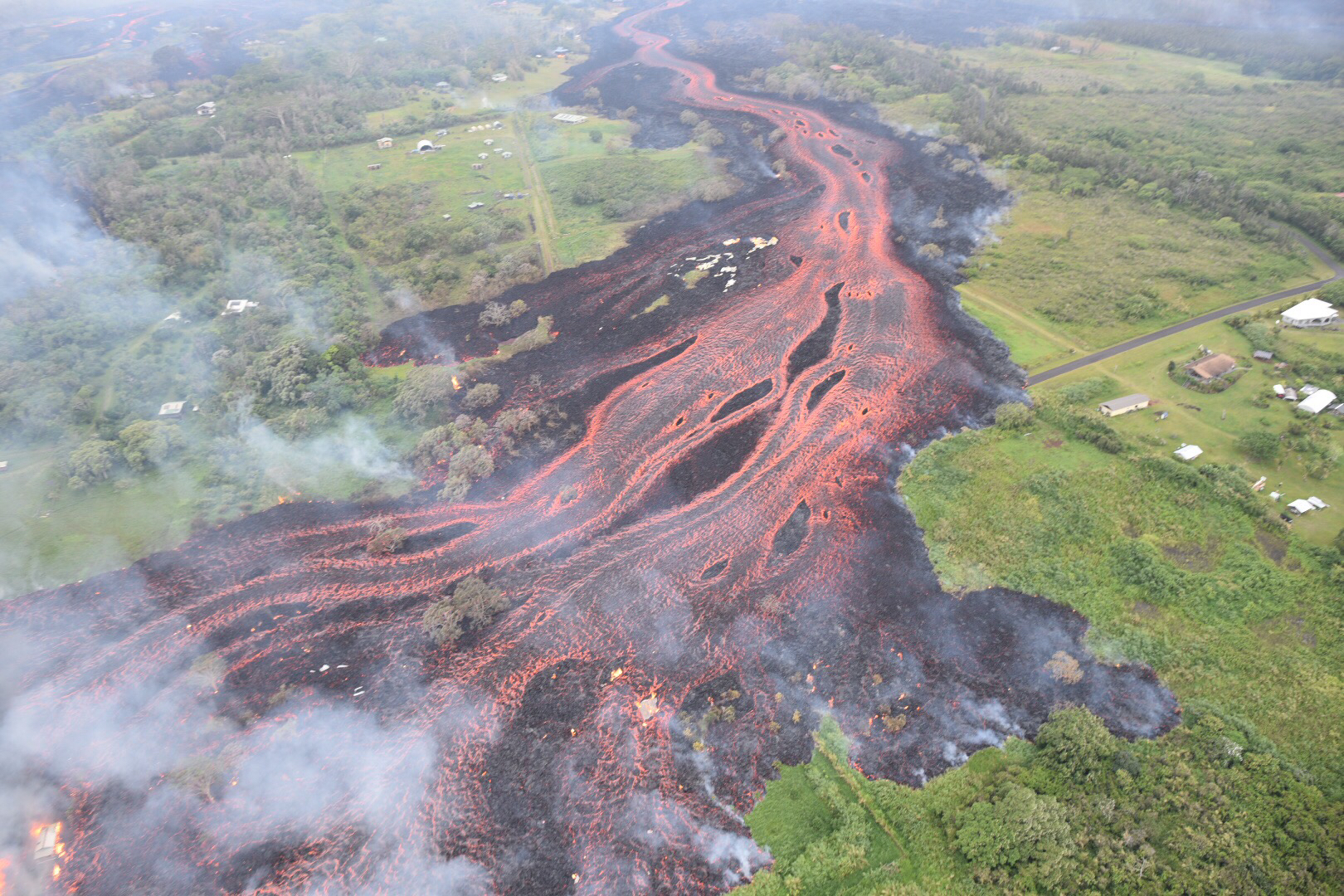
USGS aerial view of lava flow, May 19. (full-sized)
Volcanologist Erik Klemetti pulls everything together for us, reviewing how the Leilani Fissure lava eruptions and the summit ash/steam eruptions have progressed.
The eruption at Kīlauea is still captivating the nation, as it should because this volcano hasn’t behaving like this in almost a century. I thought I’d take a moment to step back and review of the main events so far and what it might all mean for Kīlauea and the people who live around the volcano. These eruptions are separated by a long way if you look at the satellite data and should almost be treated at two different events..
Also, here’s today’s CivilDefense briefing and BigIslandVideonews’ splice of afternoon USGS briefing with geologist Carolyn Parcheta plus recent video footage.
Taking from video (basically telling us which fissures are doing what):
The first two weeks of sputtering fissures, slow-moving flows were prelude. Thursday night, the rivers and fountains of runny pahoehoe lava arrived. Today, Saturday afternoon, the overflight videos are historic.
From USGS (loud helicopter):
Fissures 16-20 joined up this Saturday and are marching towards the ocean, expected to cross Highway 137 tonight. Civil defense warns to keep away from ocean entry, if/when the lava reaches the shore, to avoid “laze.”
From Mick Kalber:
I have no words.
Well, okay, I do. I hope everyone down there is safely away. It’s been a hard day for a bunch of people who can’t go home now.
HNN posted a brief video recap of some of the incredible lava river/fountains last night, identifying it as Lanipuna Gardens (I wasn’t sure.)
Today, Honolulu Civil Beat just left the camera on, and the lava just keeps coming.
Yep, Rusty the Rooster is still trying to tell us it’s morning.
However, despite using a still from dawn Friday morning showing Fissure 17 at its most glorious, its cinder cone is now much higher than it is.
Friday night it was incredibly spectacular, but by Saturday the group of combined fountains at Fissure 20 had taken the spotlight, sending vast amounts of Pahoehoe down to the ocean. That said, 17 continued be loud; it’s the one that sounds like a thundering detonation or jet engine in short, loud bursts.
I wasn’t going to do this, because hazard information is best left to emergency officials and experts.
But I don’t want the videos and images I’m sharing to mislead people into thinking this event is larger-scale than it is. It’s overwhelming to those who have lost homes or had to evacuate. I don’t want to downplay what they’re going through. At the same time, major hazards are confined to a very limited area, yet news media are whipping this up to apocalyptic proportions and tossing out headlines with “fears” and “anxieties” and “major” to scare people. I don’t want to add to their hype. A volcanic eruption one can watch from a few miles away without dying is moderate, not major.
So let me try to give a rundown of Kilauea hazards, and why I think it’s not greedy nor crazy for officials to be urging tourists not to cancel their visits.
USGS reports another explosion last night: “At 11:58 PM Local time, a short-lived explosion at from Halema’uma’u created an ash cloud that reached up to 10,000 ft asl and was carried southwest by the wind. Possible trace ash fall may have occurred along Highway 11.”
I’m not sure whether this was a steam explosion, or just yet another of these rockfall-triggered ashclouds, like this one in 2011:
Hawaii Volcano Observatory is so lucky to have one of the foremost experts in explosive eruptions, Don Swanon, who worked on St Helens so long ago and uncovered Kilauea’s explosive history after transferring to HVO in the 90s.
Experts on this active volcano gathered to share what they know- and what they have discovered is Kilauea has a history of explosive ash eruptions. Hawaiian Volcano Observatory geologist Don Swanson sums, “For the past 2,500 years we’ve had explosions more than 50% of the time, so this is the norm for Kilauea. But most of the explosions are minor, like we saw today, with small plumes of ash and steam rising from the summit.”
Thursday May 18: Fissure eruptions went into overdrive [Good article from Star-Advertiser] as “fresher, hotter magma” (Janet Babb, USGS geologist) arrived from summit. Fissure 20 released a lava flow down toward coast, crossed Pohoiki Road, and isolated about 40 houses. Four cut-off residents were airlifted out.
Check out daylight screencap from late in the broadcast to get sense of scale: note house.
The USGS also posted a brief video clip of Fissure 17 in its Kilauea-Iki-like glory:
May 19, Friday afternoon, a new livestream started from same channel as before (civilbeat.org). They streamed through most of the night, occasionally shifting view from large fountain behind house (Fissure 17) to lava flow and a group of lava fountains building spatter ramparts (Fissure 20 merged with others) upslope to the right.
Friday, HawaiiNewsNow’s Milika Lincoln filmed same area in late morning from nearby location, near Lanipuni Gardens: fissure 17 fountain was now 500 feet tall. There seems to be a crater (pu’u) forming to the right of 17’s fountain. She also interviewed a resident who saw Fissure 17 form— as they talk, it roars. After dark, her crew’s footage is absolutely spectacular. (She’s calling it 19— either I’m mistaken about which one she’s watching, or she is.)
You can really tell this is hotter, fresher, more voluminous lava that drained from Pu’u O’o, as opposed to the old, stiffer, cooler lava that erupted from fissures in Leilani Estates the first two weeks of this eruption.
“Ground deformation is continuing with increased seismicity” in Lower East Rift Zone, and USGS warn lava inundation below them is possible, and that more fissures could still open uprift or downrift. “All fissures are actively spattering or actively degassing.” 40 structures lost.
May 17, 4:17 AM, the first honest-to-gosh steam explosion like they’ve been predicting (instead of just a rock and lava explosion) sent an ash cloud up 30,000 feet. Gemini Observatory caught it on timelapse:
According to volcanologist Erik Klemetti, the blast threw some 1000-pound blocks, the only place I’ve seen this. See blog post (more pics).