June 16: Things Moving Sideways or Down Quite Rapidly

HVO’s Kilauea Summit Livestream caught today’s Halema’uma’u “subsurface explosion” (is that what we’re calling them now?) and — wow!
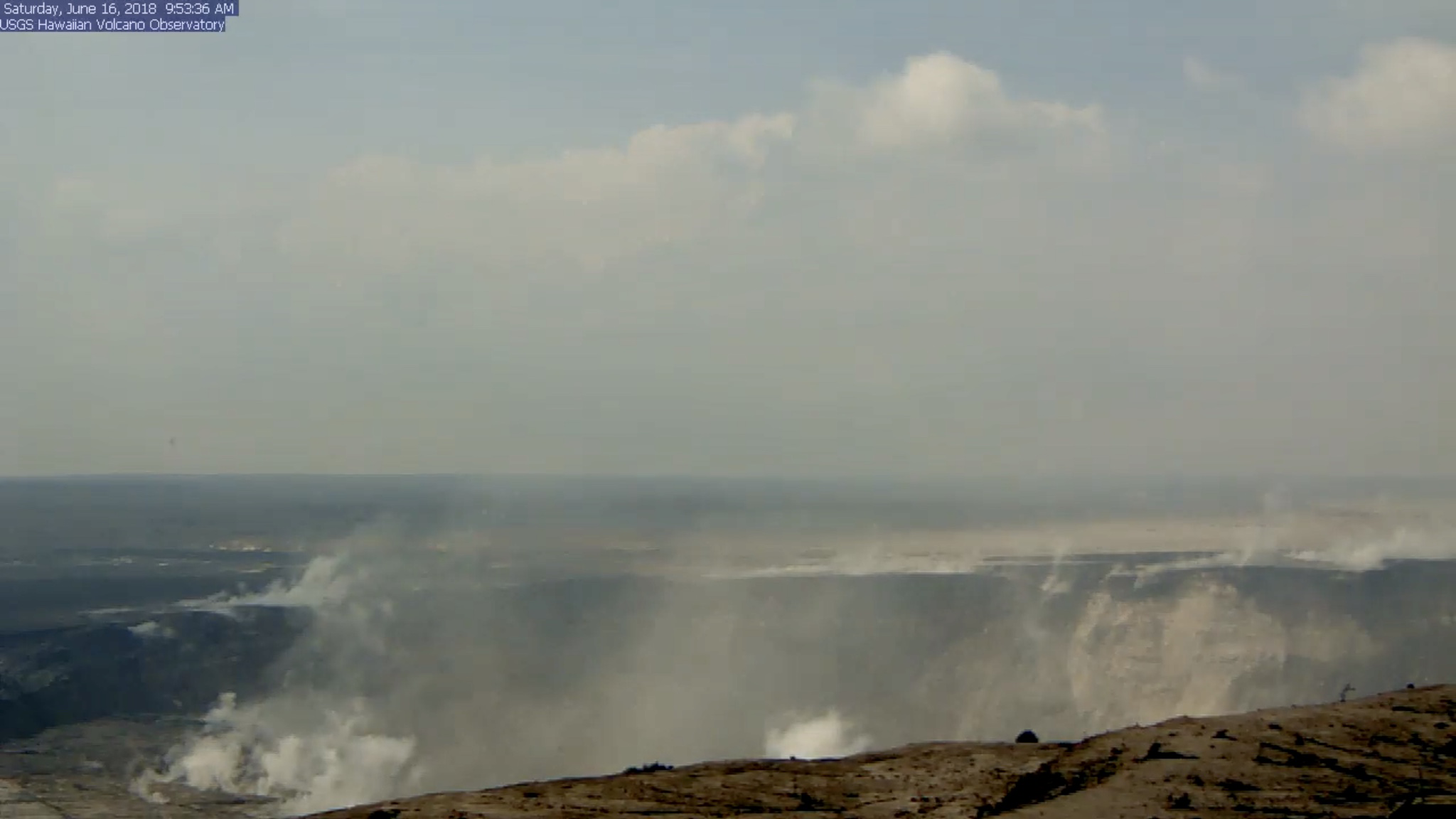
Halema’uma’u BEFORE: screengrab of USGS/HVO Kilauea Livestream before the day’s explosive event. I’ve boosted the exposure to bring out details. (Jun 16, 2018)

(a few hours later, when, luckily, it was still possible to rewind the livestream back to the time of the explosion, since I missed it.)
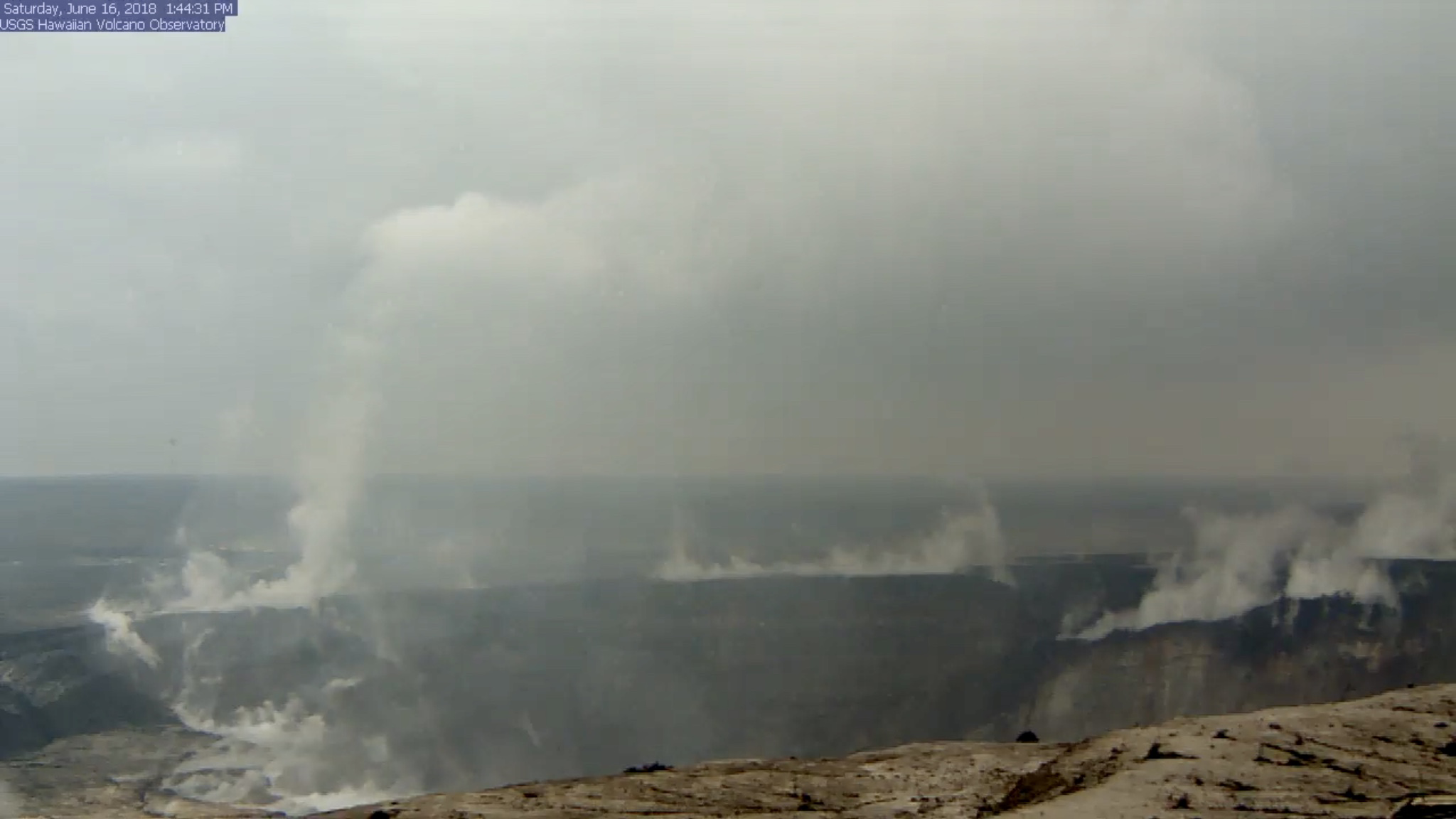
Halema’uma’u Crater AFTER: screengrab of USGS/HVO Kilauea Livestream taken later in the day after the dust had settled. Look at that big chunk of the rim that dropped on the right!

We’ve been hearing about subsidence, slumping, and rockfalls for weeks, but there’s nothing quite like seeing it, even if the video’s a bit fuzzy. I took the liberty of saving a clip:

Radar showed the plume was less than 7000 feet, and as usual the energy release checked in at 5.3.

While I rewound the livestream to grab that clip before it fell off the “back” of the livestream conveyor belt, it looks like I jumped right over this:

There was still a column of steam at that spot when I checked an hour later, but I don’t recall it spinning.

Okay, enough fiddling with the livestream. 

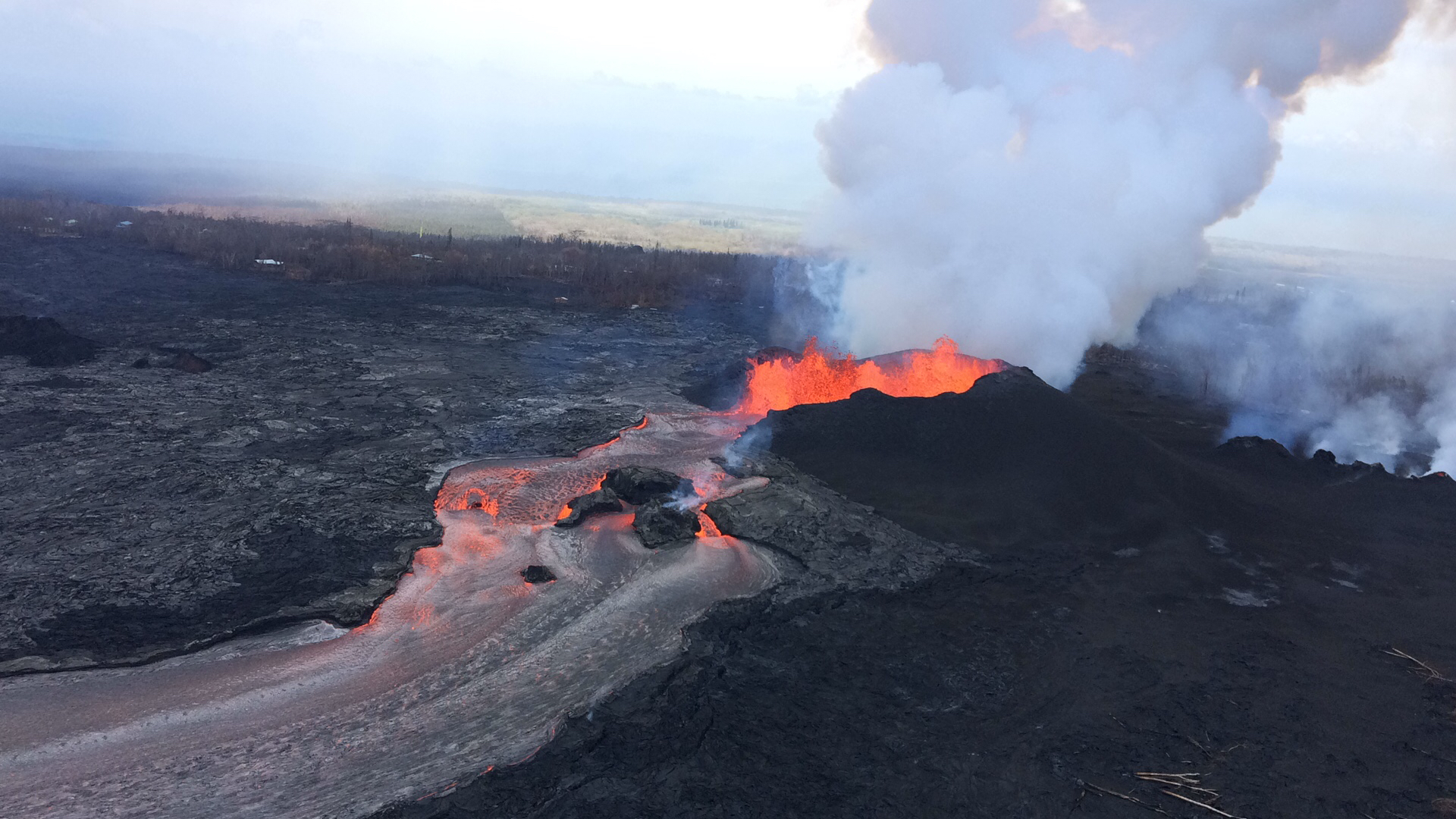
What else happened today? Same as the last few days, to the point that I had to double-check the date on today’s HVO  Kilauea status report.  Fissure 8’s cone is holding at 170 feet, fountains currently around 185-200 feet. Fissure 16/18 continues to ooze.

The lava river is running as fast as ever:

Despite the increased vog due to lack of tradewinds, that’s the clearest overflight video I’ve seen in days.

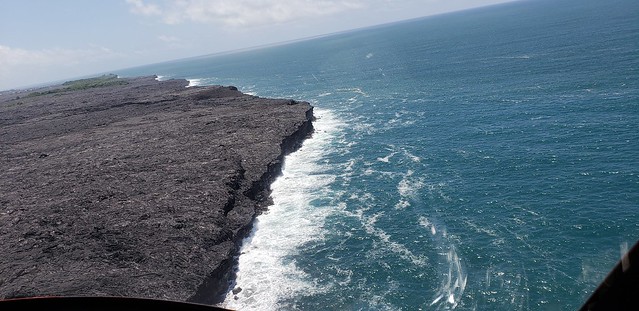
Mick Kalber notes the pahoehoe channel now cuts all the way through the a’a field to the ocean, which may explain recent videos of lava racing at amazing speeds…

Continue reading June 16: Things Moving Sideways or Down Quite Rapidly

June 12: Steve Brantley (USGS) Weekly Talk on Eruption

I didn’t realize I’d missed one of Steve Brantley’s excellent 10-minute slideshow presentations at the weekly Puna Community Meetings. This one took place on Tuesday, June 12 at Pahoa High School.

I learn something from every one of these talks, which sum up Kilauea eruption activity of the past week in a way that’s easy for the general public to understand without talking down to them.

Video of meeting is archived here. Steve’s presentation starts at timestamp 42:10. Where possible, I’ll be including images in my transcript which match his slides.

(Steve Brantley is a USGS geologist, deputy-scientist-in-charge of Hawaiian Volcano Observatory.)

Transcript

Hello everybody. Thank you for coming out again and thank you for your perseverance. I’ll show a couple slides of what’s been happening down in this part of the neighborhood and end with some slides of the summit area, which continues to change very dramatically.

Cutaway Diagram of Kilauea Volcano, adapted from USGS Characteristics of Hawaiian Volcanoes. (I’ve adjusted text and drawn arrow to match Steve Brantley’s slide in his presentations.)

So this is  the overview slide I’ve showed for the past few times. It gives you the overall picture. It’s an image, cartoon, from the summit area all the way out to the eastern tip of the island. The summit area here [under “Kilauea Caldera” label], eastern tip [down by “Kapoho Crater”], with a cross section showing you the general picture of the magma reservoir system from the summit of the volcano down through the East Rift Zone and into the Lower East Rift Zone.

Continue reading June 12: Steve Brantley (USGS) Weekly Talk on Eruption

June 11: USGS Press Conference (Halema’umau Subsidence, Ocean Upwelling)

At a 3PM press conference, Jim Kauahikaua (USGS geophysicist) described in detail the subsidence at Halema’uma’u. He also talks about a patch of “upwelling” where lava has entered ocean at Kapoho and seems to be traveling along ocean floor, heating water above it.

(Transcript below the cut)

Continue reading June 11: USGS Press Conference (Halema’umau Subsidence, Ocean Upwelling)

June 11: Summit Hiccups, Ocean Entry Upwelling

Fissure8’s “three closely space fountains” are starting to climb down, reported at 115-130 feet last night, and “fluctuating heights from below the 115 ft high spatter cone around it up to 180 feet” this afternoon. But its lava flow is still full to its banks, entering the ocean in Kapoho with minor steam explosions. “Weak lava activity” was spotted at fissure 16/18 last night.

USGS: “The three closely spaced lava fountains at fissure 8 reached maximum heights of 115-130 feet overnight. Lava fragments falling from the fountains are building a cinder-and-spatter cone around the erupting vent, with the bulk of the fragments falling on the downwind side of the cone. Fissure 8 continues to feed a channelized lava flow that reaches the ocean at Kapoho.” (Full-sized)

Last night, Kilauea’s summit hiccuped: there was a small explosion at 12:46am, after which, seismicity did not drop off until after another, larger explosion at 4:43am like the ones we’ve seen lately (registered as M5.4).

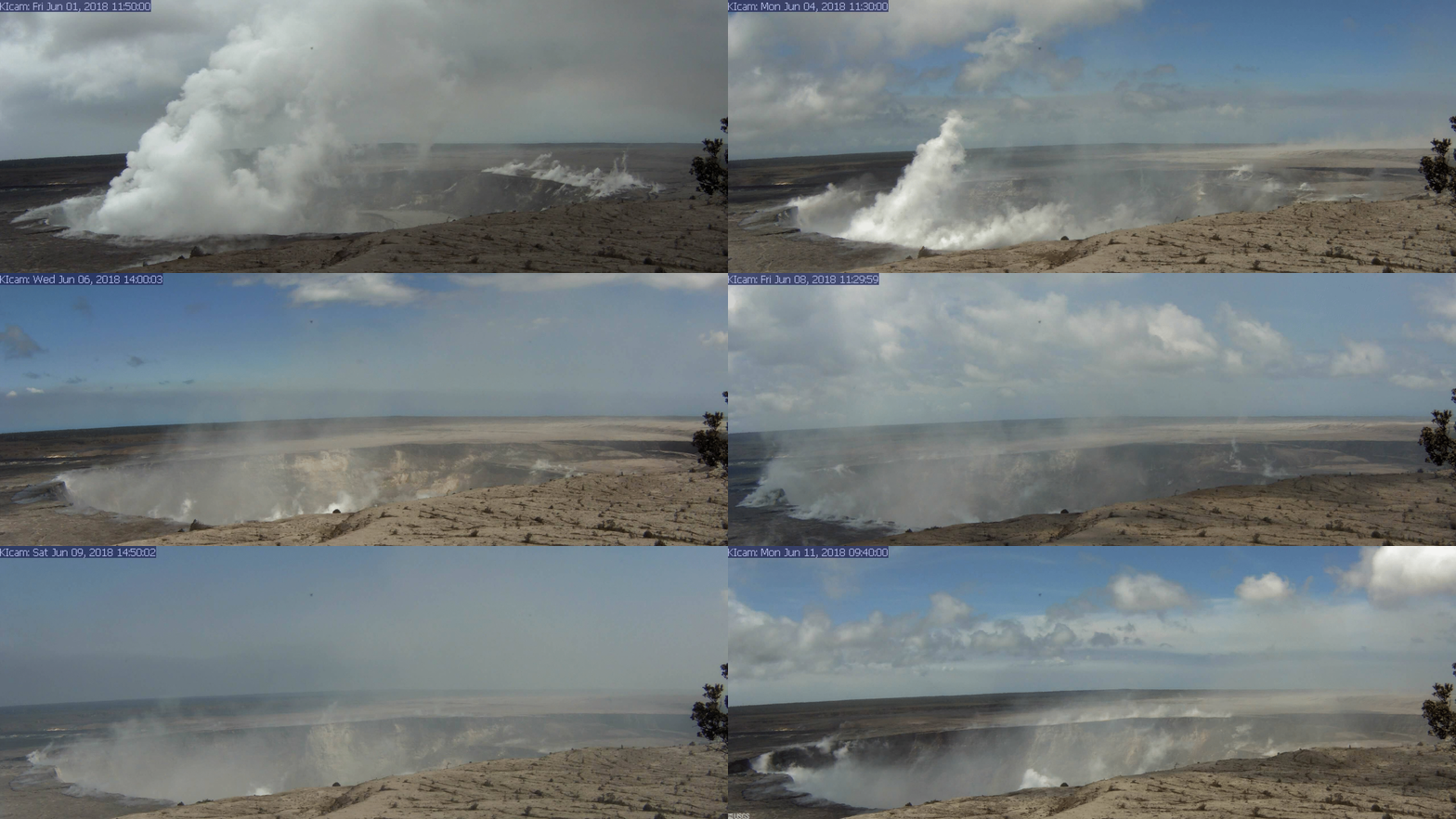
USGS: “A series of wide-angle webcam images, captured by a camera in HVO’s observation tower between June 1 and June 10, 2018, show ongoing subsidence around Halema‘uma‘u at the summit of Kīlauea in this animated GIF.” (Full-sized)

Since Saturday, Fissure 8’s gas emissions have been much higher than last week, whereas summit SO2 is half what it was before the current eruption. (I’m not sure why HVO’s Kilauea alerts report “volcanic gasses” for one and only SO2 for the other.)

(The “Lava Livestream” house is still safe, if marooned, near white mast): 

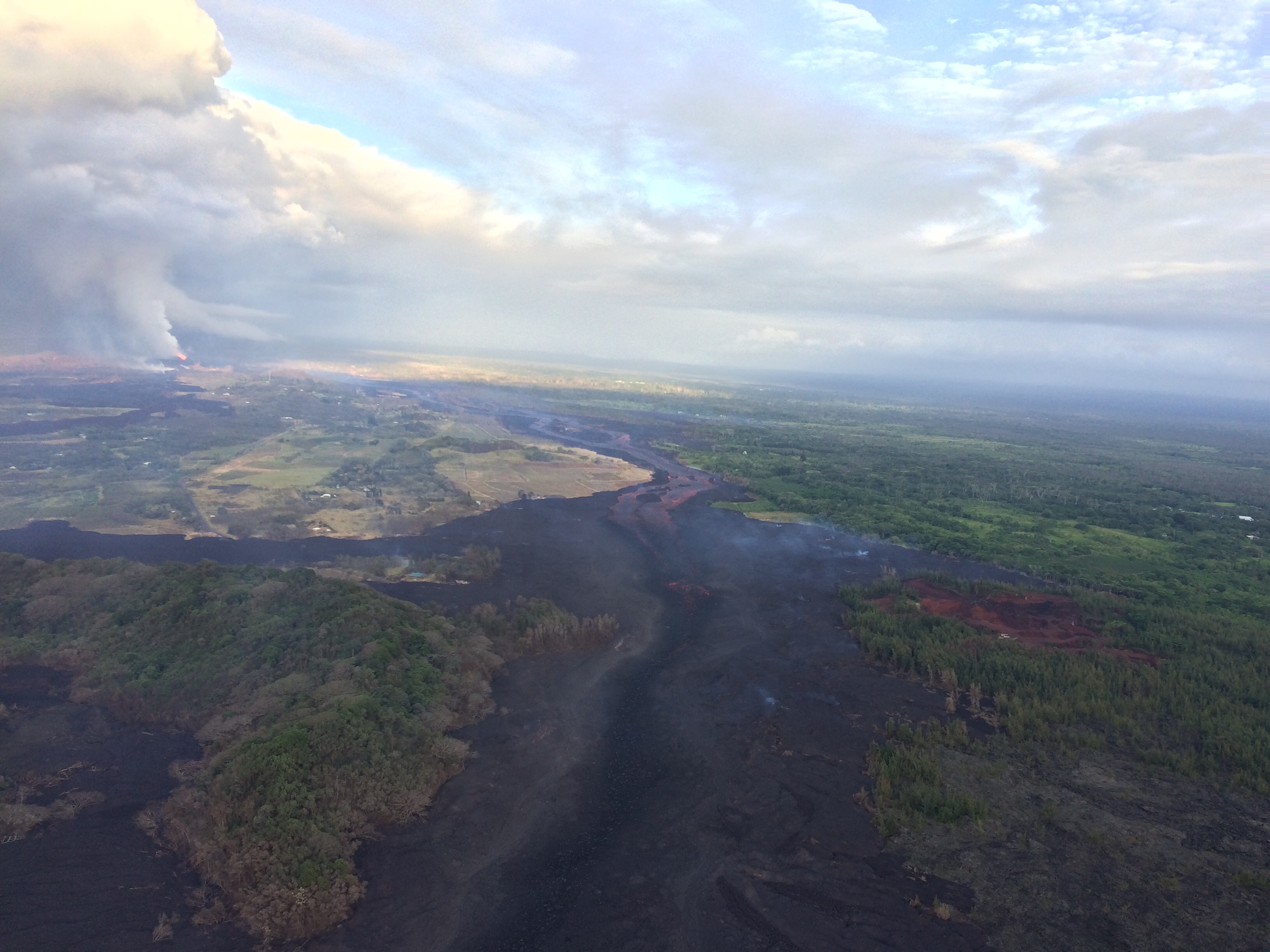
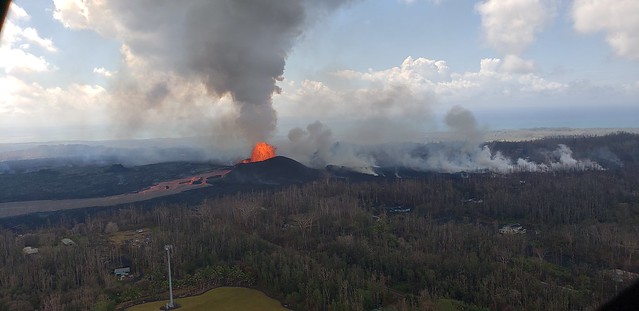
USGS: “Aerial view of the fissure 8 lava channel on Kīlauea Volcano’s lower East Rift Zone in the vicinity of the Kapoho cone, with fissure 8 fountains visible in the distance (upper left). Helicopter overflights of the eruption site are routinely scheduled to check for any new outbreaks of lava and to collect GPS data on the active flow—information that’s needed to make the flow field maps that are posted on HVO’s website” (Full-sized)

Here’s a double feature from Mick Kalber’s daily overflights— below is his June 11 lava video, but I missed his June 10 flyover vid and lava update notes.

Below the cut: more great images, overflight vids, and some interesting USGS answers to questions on social media.

Continue reading June 11: Summit Hiccups, Ocean Entry Upwelling

June 8: A Voggy, Voggy Day

Today’s eruption summary

…Status quo continues another day.

Kilauea, HI - East Rift Zone Eruption Event - 06/08/18 Photos and Video

Fissure 8 continues to do its thing (fountains up to 230 ft today), pumping a vast river of lava towards Kapoho. Its flow front is about a mile wide where it meets the ocean. USGS reported ~190 acres of new land added to Hawaii as of noon. Some or all of this may be temporary, since “lava deltas” tend to collapse.

Kilauea, HI - East Rift Zone Eruption Event - 06/08/18 Photos and Video

[Above: 2 photos from Hawaii County Fire Department’s extensive videos/photos for June 8. Good to browse if you’re checking on homes in Kapoho.] 

Summit activity continues to follow its geyser-like cyclical pattern. Earthquakes increased until 2:44 AM, when there was an explosion (equivalent of M5.4), after which seismicity died down.  Pu’u O’o also had a small earthquake (3.2) and rockfalls today, sending up a red plume of ash. (Still hunting for photos, but it’s been reported several places.)

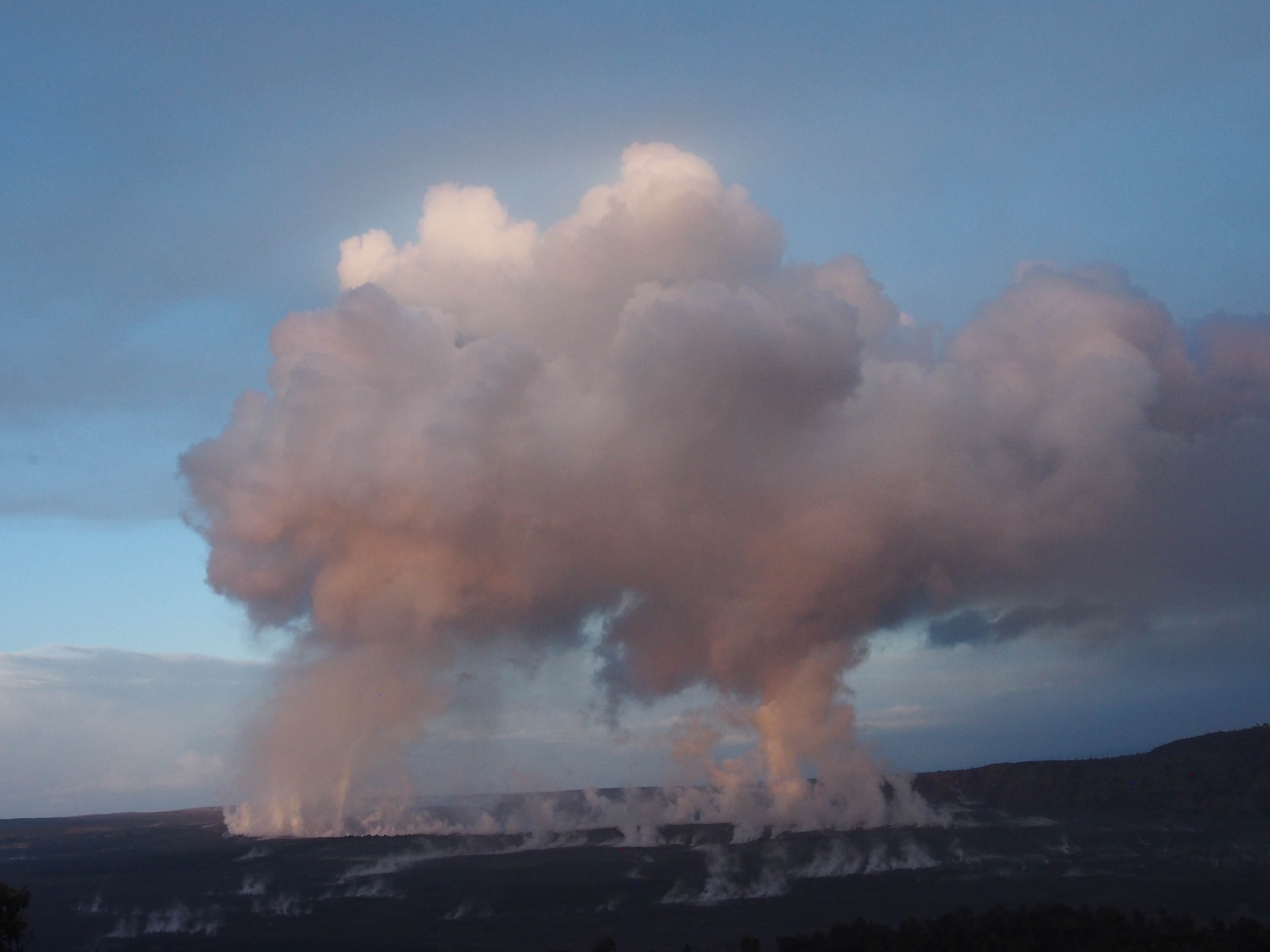
USGS: “Outgassing from Halema‘uma‘u produced twin pillars that rose in the still morning air and merged into a towering cap above the summit of Kīlauea just after sunrise.” (Full-sized)

East and southeasterly winds sent an unpleasant amount of vog over Hilo and the Saddle. This will continue through Saturday, then tradewinds come to the rescue.

Today’s Kilauea Alerts, Videos, Images, and Eruption News

Continue reading June 8: A Voggy, Voggy Day

June 6: Summit Explosions Explained (And Predicted!)

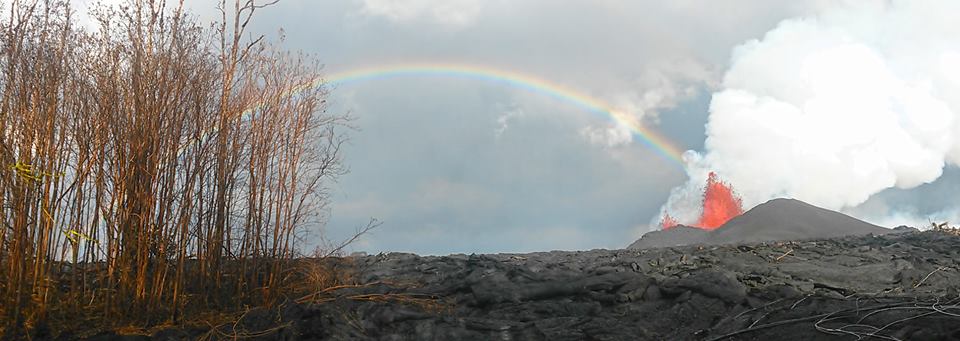
USGS/HVO photo of Fissure 8, spatter cone and rainbow, June 6.
Today’s Eruption Update:

Last night, USGS scientist Steve Brantley explained the current eruption in an informative 10 minute talk. I transcribed it as a separate post, but here’s a rough summary: Magma heading down to the Lower East Rift Zone is causing the summit to deflate. Deflation is causing a pattern of more and more earthquakes over 30-50 hours until the summit releases the strain with an explosion, accompanied by an ash cloud.

Sure enough, there was an M5.6 explosion and 10,000 foot ash cloud at 4:32pm. HVO’s Twitter account had a great impromptu Q&A session about it (see below).

Meanwhile, down in the Lower East Rift Zone, Fissure 8 shows no signs of slowing. It’s wiped out Vacationland and nearly all of Kapoho Beach Lots, and is continuing to create new (crumbly, hazardous) beachfront real estate.

USGS has also been posting some striking imagery today.

Video description: “HVO’s mid-day overflight on June 5 shows ongoing partial collapse of Halema‘uma‘u at the summit of Kīlauea Volcano. To the north of the former visitor Overlook parking area (closed in 2008) is the site of the former lava lake—now a deep hole piled with wall-rock rubble. The western portion of Halema‘uma‘u has moved down and toward the center of the crater as new cracks form on the caldera floor to the west. Kīlauea’s summit continues to subside due to withdrawal of magma towards the volcano’s East Rift Zone.”

They’ve also posted drone footage of Fissure 8 lava flow on June 3. Houses give a sense of scale:

(Link to video description)

Here’s this morning’s USGS helicopter overflight of Fissure 8:

More images, lots of great geology info below the cut. But first, a 2-minute USGS briefing, since we skipped yesterday’s:

Continue reading June 6: Summit Explosions Explained (And Predicted!)

June 4: Lava Enters Kapoho Bay

june 4 Kilauea Eruption Summary / Infographic by USGS
Text version at link: June 4 Kilauea Infographic, HVO/USGS

Latest numbers: 
Lava coverage ~7.7 square miles, 19.9 square km, 4917 acres.
Janet Snyder, spokesperson from Hawai’i County Mayor’s Office, says at least 117 homes destroyed, but Civil Defense admin Talmadge Magno says probably “a lot more”

Here’s a video clip and two screengrabs to sum up Kilauea’s activity today: a half-mile-wide a’a flow pouring into Kapoho Bay and slowly filling it, while the summit steams weakly after a 5.5 earthquake yesterday.

Kapoho Bay, USGS overflight, 6:13am (HST) this morning:

Screengrabs from the Halema’uma’u and LERZ webcams about 3pm:

Taken from Overlook Vent Wide Angle Webcam, HVO/USGS, Jun 4, 3pm local time. Only light steam.
Screengrab from USGS/HVO Lower East Rift Zone webcam, June 4, 3pm. Fissure 8 still fountaining away with broad lava flow issuing to right (northeast), heading down to Kapoho.

ETA: Oh, look. Perfect angle of the sun right now.

Jun 4, 6:20 pm – Nice webcam image from HVO.

Additional info from HVO morning status report: “Local videographers reported that lava entered the ocean at Kapoho Bay at about 10:30 PM HST on June 3. […] A lava breakout is also occurring upslope [north] of the Kapoho cone cinder pit, with active flows about 330 yards southeast of the intersection of Railroad Avenue and Cinder Road..   […]Following the small [M5.5] explosion at about 3:50 PM HST on June 3, earthquake activity at the summit has been low. Inward slumping of the rim and walls of Halema`uma`u continues in response to persistent subsidence. ”


June 4 Kilauea Eruption Digest:
  • USGS Info/Updates
  • Posts from Other Geologists
  • National Park Damage Report
  • News from Hawaiian Media
  • Images/Videos From Social Media

Continue reading June 4: Lava Enters Kapoho Bay

May 26: Lava Turns Towards PGV

Puna residents watch with a sinking feeling of “I told you so” as a ponderous a’a flow crossed Pahoa Pohoiki Road slightly north of the geothermal plant, inching towards it. Officials think they’ve got the wells quenched  (I notice they quietly dropped the idea of plugging them), and that they’re safe.

Hawaii County photo looking south across Pohoiki Road, geothermal plant bottom left. Photo not timestamped but probably around noon. “Fissures 7 and 21 are feeding an ‘a’ā flow that has advanced to the northeast and this afternoon crossed Pahoa Pohoiki Road onto PGV property, USGS reported.”

Meanwhile, Fissure 7 is causing trouble in all directions; its lava pond has sent another flow “cascading into Pawaii crater” (6:15pm).  Looking at the map, I’m betting that crater is an old vent from a previous fissure eruption just like this one. In addition to fluid/runny pahoehoe flows, some of the longer flows are a’a.

The summit has also been busy today, with three ash explosions reaching the ~10,000 foot height between midnight and dawn, and some reaching “as high as 12-13K‘ [above sea level]” this morning. Reminder: Kilauea is 4009 feet above sea level (asl).

Moving on. I’ve gotten in the habit of checking the Lower East Rift Zone webcam last thing before I post:

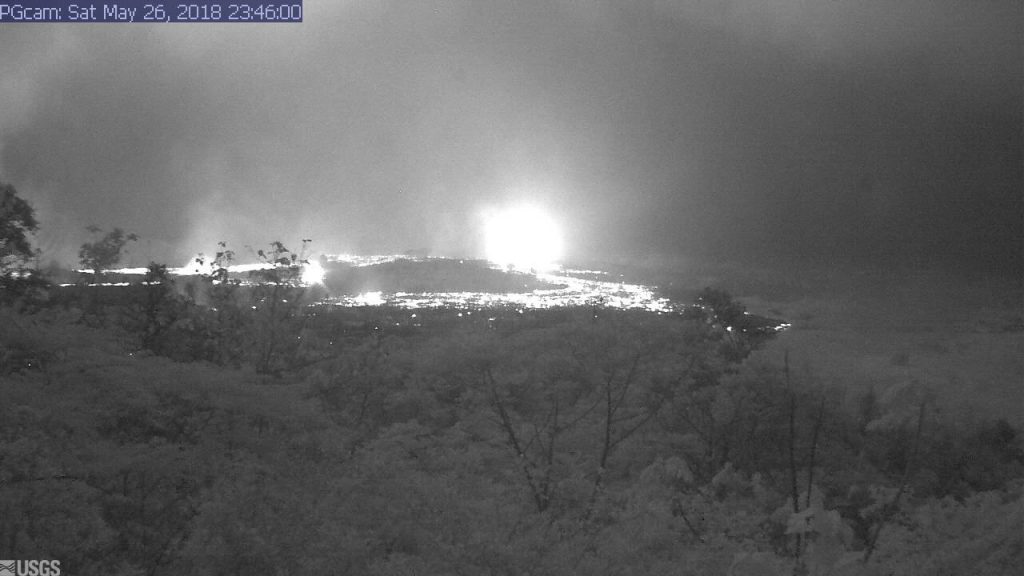
USGS webcam of LERZ. Grabbed just before midnight, May 26. Is that a lava flow coming towards the camera?

Next image on the LERZ webcam.

I do believe it is. Has that lava pond broken loose?

Lava tally as of Saturday morning: 41 houses, 82 structures total. A further 37 homes isolated by lava crossing roads. Lava has covered 3.7 square miles/2372 acres so far.

Here’s the usual roundup of the day’s eruption news, astonishing views, and geeky info by geologists:

Continue reading May 26: Lava Turns Towards PGV

May 23: Blue Flames? Now You’re Just Showing Off

Kilauea’s chief resident has found another way to amaze and/or injure people reckless enough to get too close to her redecorating:

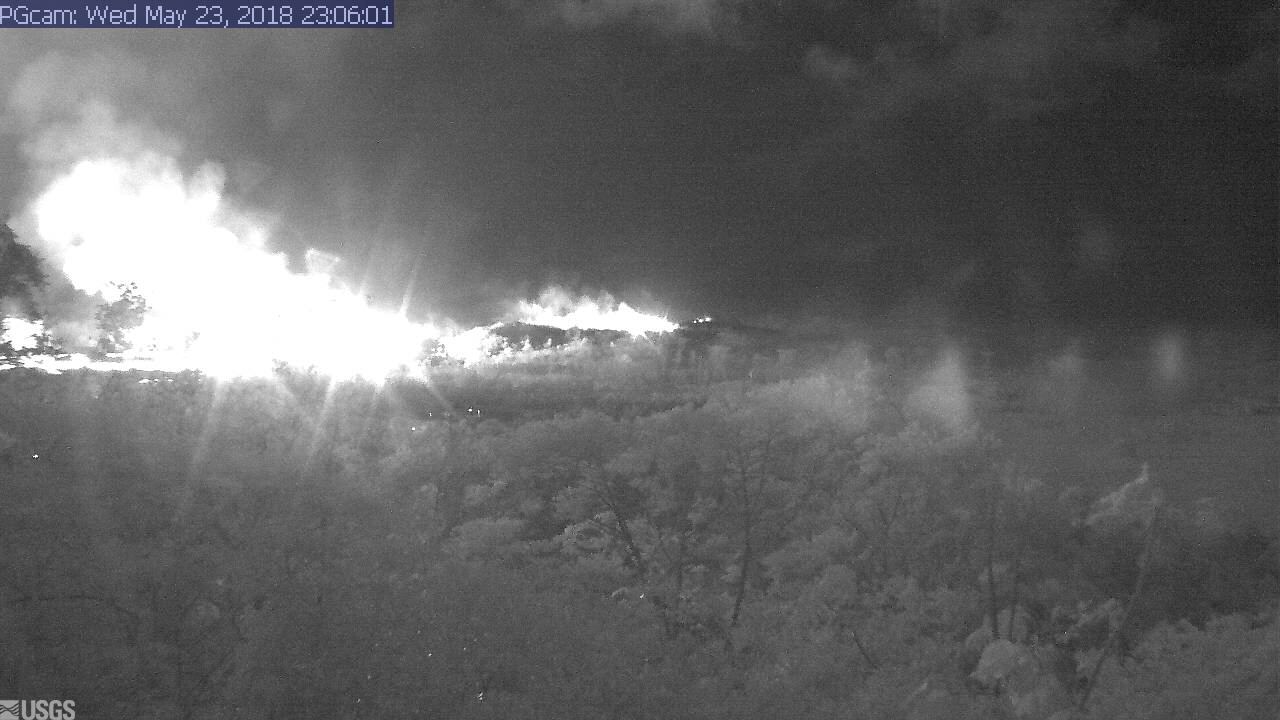
I had a hunch the Lower East Rift Zone webcam would be interesting tonight. I wasn’t disappointed:

I see what they mean about the Leilani fissures further west (uprift, towards the camera) reactivating today.

Edited to add: Yikes.

It’s 11:06 PM in Hawaii; second screengrab an hour or so later.

I was about to hit post, when I saw erstwhile reporter Mileka Lincoln and her crew posted this. Wow.

(recorded just an hour ago at time of this post.)

Now, let’s have the evening roundup of poignant news, amazing views, and interesting science…

Continue reading May 23: Blue Flames? Now You’re Just Showing Off

May 21: Daily Roundup, Fire & Water Edition

Mick Kalber’s daily helicopter flyover includes some intense views of the rivers of lava heading into the ocean, and the big complex of fountains— 20? 22? we’re starting to lose track— that have dominated the Lava Livestream With Rooster for the last several days.

May 21 Fissure Map (USGS Maps page)

The USGS thermal scan is very informative, too: an infrared satellite detects heat sources (the whiter the image, the hotter it is), and USGS then overlays it on a daylight satellite image of same area. Result, accurate map of where the main flows are, even when they crust over so the lava inside is hidden:

May 21 Heat map of today’s flows (USGS Maps page)

Below the cut: a digest of the day’s eruption news, USGS updates (summarized), and striking social media images and video clips like this:

Continue reading May 21: Daily Roundup, Fire & Water Edition